
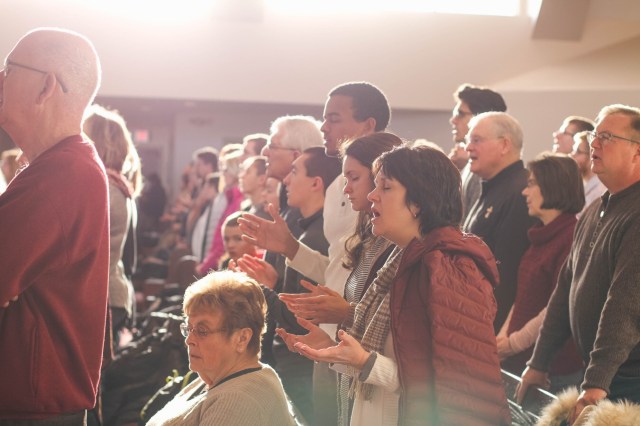
Yesterday as I was surfing the web through the many articles which have been written, I came across this one from Tim Challies, This Is Not Your Grandparents’ Church. I must admit, my initial reaction was a little negative, because I have been in churches where the young are devalued.
Tim was writing about the old being devalued during the era of the church growth movement,
One of the ugliest boasts of so many of the churches created during the era of the Church Growth Movement was this: This is not your grandparents’ church. This was a slogan they proudly broadcast on signs outside their multi-function ministry centers, a motto they printed on postcards and mailed to nearby homes. Just about every upper middle class neighborhood in North America got at least a few of these in the late 90s and early aughts.
These churches meant to communicate “this is a new kind of church—one fit for the modern world.” They wanted to indicate that younger folk—those who had wandered from the traditionalism of their parents or fled the fundamentalism of their grandparents—would find a safe place to hear about Jesus and learn about the Christian faith.
One of my favorite lines from Challies’ article is this,
After all, it’s gray hair, not a man bun, that God declares a crown of glory. We are to rise in the presence of the aged and wise, not the young and hip. It’s the weak who are most worthy of special welcome, not the strong. It’s the helpless who most merit our attention, not the affluent.
The church growth movement of the 90’s fed or grew off the culture I was raised in, where traditionalism was king and the young didn’t have a voice. The leaders knew the demographic they were after, they heard their voice and marketed to it accordingly. As a Christian growing up in this era, I must admit these churches were attractive and appealing, we had a few pop up when we were living in Oregon in our neighborhood. It was tempting to go check it out but we stayed where we were, because what we need are humility driven multi-generational churches.
Multi-Generational Churches
I believe a church needs people from every era of life in order for the church to thrive and grow. We need the wisdom, knowledge, prayers and experience of those who have been around the block, who have lived life who have seen the latest fad come around for the second or third time. We also need those middle-aged folks, young adults, youth, children and those in the nursery.
Paul describes the church as a body each part playing their role in 1 Corinthians 12. Christians of every age are gifted and have a role to play in the community of believers. While many times the young are still trying to find their role, those later in life are laser focused.
I experienced this when I led a drama ministry at our former church. I would hover through the different teams and I would see a room full of senior citizens hanging out into the late parts of the evening, because they were waiting for a group of people to counsel and pray with who have just experienced our drama ministry. At the same time I’ve seen the middle age and young play their role in the very same ministry. Every one working in conjunction to accomplish the goal of sharing the Gospel. When we see the generations coming together to accomplish the goal of sharing the Gospel it is a thing of beauty.
The unfolding plan of God throughout the scriptures is to have older godly mature men and women teach the young. The book of Proverbs is filled with wisdom from an older wiser father to his son, to prepare him for life. Paul also tells Titus,
Older women likewise are to be reverent in behavior, not slanderers or slaves to much wine. They are to teach what is good, and so train the young women to love their husbands and children, (Titus 2:3-4 ESV)
The young are dependent on the old for training, wisdom and knowledge to grow up into maturity. The old are dependent on the young to receive the training and carry on the legacy.
I have also experienced the other end of the spectrum when the elderly and the young are at odds. Where tradition and “this is the way we have always done it” is king and the fresh ideas are thrown to the wayside.
Could it be that fractures that are seen in churches between the generations are ploys of an enemy to create a generation gap, to dampen the churches Gospel witness?
Humility Driven Multi-Generational Churches
We need humility driven multi-generational churches. When I say humility driven I am thinking of Philippians 2,
Do nothing from selfish ambition or conceit, but in humility count others more significant than yourselves. Let each of you look not only to his own interests, but also to the interests of others. (Philippians 2:3–4 ESV)
I remember talking to an elderly couple who was part of a church plant of mostly young people, I asked them what prompted them be a part of the church plant? They said they wanted to see the Gospel go forth in the city, the music is a little loud, we don’t sing only hymns, but this is our place.
I loved it! Humility driven, pushing aside personal interest for the goal of the Gospel. At the same time, the church is aware of them, by playing hymns in their worship set. Acknowledging their wisdom and importance in their church plant.
I am attending a congregation that is committed to doing things in Spanish/English. There are people who only speak English, there are those who only speak Spanish and there are some who speak both. This takes laying aside your own interests for the interest of others, reaching the Hispanic community with the Gospel. It is a beautiful thing to see.
Humility driven multi-generational churches are not focused on self interest, they look to the interest and needs of others. These churches are not driven by preferences but each generation serving the other. The widow praying for the church, the young serving the widow through fellowship, yard work etc. To see the generations working in tandem for the glory of God is the goal and when it is actualized in the church the beauty of God is on display.
Until Next Time
Soli Deo Gloria
 Josue Aguilar