
Meditation Monday: Things Done in The Corner

image2

I was a child and I have children, so I know, when children want to hide things the go to a hidden part of the house, behind a tree, or a shady corner. They are doing this to keep from getting in trouble or others finding out their secret. They are trying to be sneaky.

In Acts 26 we read of Paul’s fourth trial, he has appealed to Caesar and is awaiting transport. Agrippa comes to town and Festus consults him for advice on what to do with this unjustly imprisoned prisoner. Who knows what Agrippa has heard concerning Paul, I speculate he has heard much of Paul’s activities.

Paul now has the opportunity to share the Gospel by sharing his story. He shares his Damascus road experience and his mission given to him by Jesus. He also explains his faithfulness to that mission is why the Jews want to kill him. Paul says enough about how Jesus transformed me, let me tell you about how He can transform you. Jesus who was foretold by the prophets, suffered and died and rose again from the dead to bring a message of light to the Jews and Gentiles.

You Are Out Of Your Mind

Festus’ first reaction is to tell Paul he is crazy. Why is it that when followers of Jesus share the Gospel people think we are crazy? Festus’ plausibility structure drove him to come to the conclusion that Paul was crazy. Joe Carter defines a plausibility structure in this way,

plausibility structures — belief-forming apparatus that acts as a gatekeeper, letting in evidence that is matched against what we already consider to be possible. Plausibility structures filter out claims that we believe cannot be reasonable or potentially true. They don’t necessarily tell us if a claim is true, only that the truth of the claim appears plausible enough for us to accept and that we are not wholly unwarranted in thinking it could be true. Whether we are gullible or skeptical, the beliefs we accumulate are those that have been filtered through plausibility structures at the individual and cultural level. These eventually form our worldview, which itself becomes a broad strainer that filters out beliefs that we won’t even consider to be possibly true.

Festus couldn’t believe because he was blinded by his unbelief, political power and the religion of Rome. Festus wouldn’t believe because he was a man in love with the glory of Rome and how the glory of Rome could give him his best life now. This was Festus’ worldview and if Christianity is true it will cause all of what Festus was living for to crumble to the ground.

Paul turns his sights to Agrippa in this courtroom drama that rivals a Perry Mason or Law and Order episode. I imagine Paul with boldness and a piercing glare telling Agrippa, “what I am saying is true and reasonable. The king is familiar with these things and I can speak freely to him. I am convinced that none of this has escaped his notice…King Agrippa, do you believe the prophets? I know you do.”

I wish we knew what was going on in the inner workings of King Agrippa’s mind. Did he think Paul was crazy? Did he think Paul was speaking the truth? Was he so in love with his sin it didn’t matter? King Agrippa left their a proud man, his final words to Paul “do you think you can persuade me to be a Christian in such a short time?”

Christ Did Not Hide In A Corner

One thing is clear from history, when Jesus came on the scene, it was more like shock and awe than kids hiding in the corner. Jesus had a very public ministry, with miraculous events popping up all over the region of Israel. People followed him in droves to hear him teach and possibly receive a miracle. The social structures were being shaken because of Christ ministry.

His ministry was a very public event, but so was his death. Hung on a cross for all to see. Festus and Agrippa could pretend this didn’t happen, but it was Roman record they knew it happened.

His resurrection was public too. Listen to what Paul writes to the Church in Corinth,

For what I received I passed on to you as of first importance: that Christ died for our sins according to the Scriptures, that he was buried,that he was raised on the third day according to the Scriptures, and that he appeared to Cephas,and then to the Twelve. After that, he appeared to more than five hundred of the brothers and sisters at the same time, most of whom are still living, though some have fallen asleep. Then he appeared to James, then to all the apostles, and last of all he appeared to me also, as to one abnormally born.

The only shady dark corner deal was between the chief priests and Roman guards,

11 While the women were on their way, some of the guards went into the city and reported to the chief priests everything that had happened.12 When the chief priests had met with the elders and devised a plan, they gave the soldiers a large sum of money, 13 telling them, “You are to say, ‘His disciples came during the night and stole him away while we were asleep.’ 14 If this report gets to the governor, we will satisfy him and keep you out of trouble.” 15 So the soldiers took the money and did as they were instructed. And this story has been widely circulated among the Jews to this very day.

To say that the Jesus of the Gospels didn’t exist or say he didn’t do what the Gospels say he did is as atrocious as saying  9/11 didn’t happen, WW II is fictional or Pearl Harbor is a fabrication.

When we read Acts 26 it is almost as if Paul is testifying before us. Will we be like Festus and just brush him off as a loon because what we have been taught doesn’t quite square up with the Gospel? Our goals in life are more about serving me than serving the Lord and my neighbor? Will we be like Agrippa and brush off the Gospel because of pride and position? Or we will be like Paul and humbly submit to the Gospel of Jesus Christ and let it be the fuel of our lifes mission in our endeavors in this world?

Until Next Time

Soli Deo Gloria

Friday Focus: A Paradise For Sinners


When you think of paradise what do you think of? What does it look like in your minds eye? I think of clear blue ocean with vibrant trees and the perfect temperature.

In today’s Friday Focus I want to point you to a sermon by Ray Ortlund Jr from Immanuel Church in Nashville TN. Ray is beginning a series in Galatians. In his sermon Ray encourages us by proclaiming that Galatians 

“leads down into the paradise that Jesus is, the paradise for sinners, Jesus welcomes the broken down in the low place. Do you realize that just by having Jesus you are free forever from anything that is against you, you are complete right now?”

If you are a follower of Christ, you are in  paradise with Christ. You do not have to be good enough to enter into his paradise. You don’t have to earn his favor to get in. For the follower of Christ the cross becomes your bridge into the paradise of God. 

When we enter the paradise of God through the cross of Christ, he changes our loyalty, our identity and our destiny.

Ray’s sermon is a great reminder that the Gospel is not just facts but something to be experienced. A conversion experience is a whole person experience, it effects the intellect, desires and emotions. I encourage you to listen to this encouraging sermon.

For those preachers out there, Ray’s sermon is an excellent example of the Gospel rich content which is found in the salutations of the letters of the New Testament and how to preach them. 

Until Next Time

Soli Deo Gloria

Things I Wish Andy Stanley Wouldn’t Say


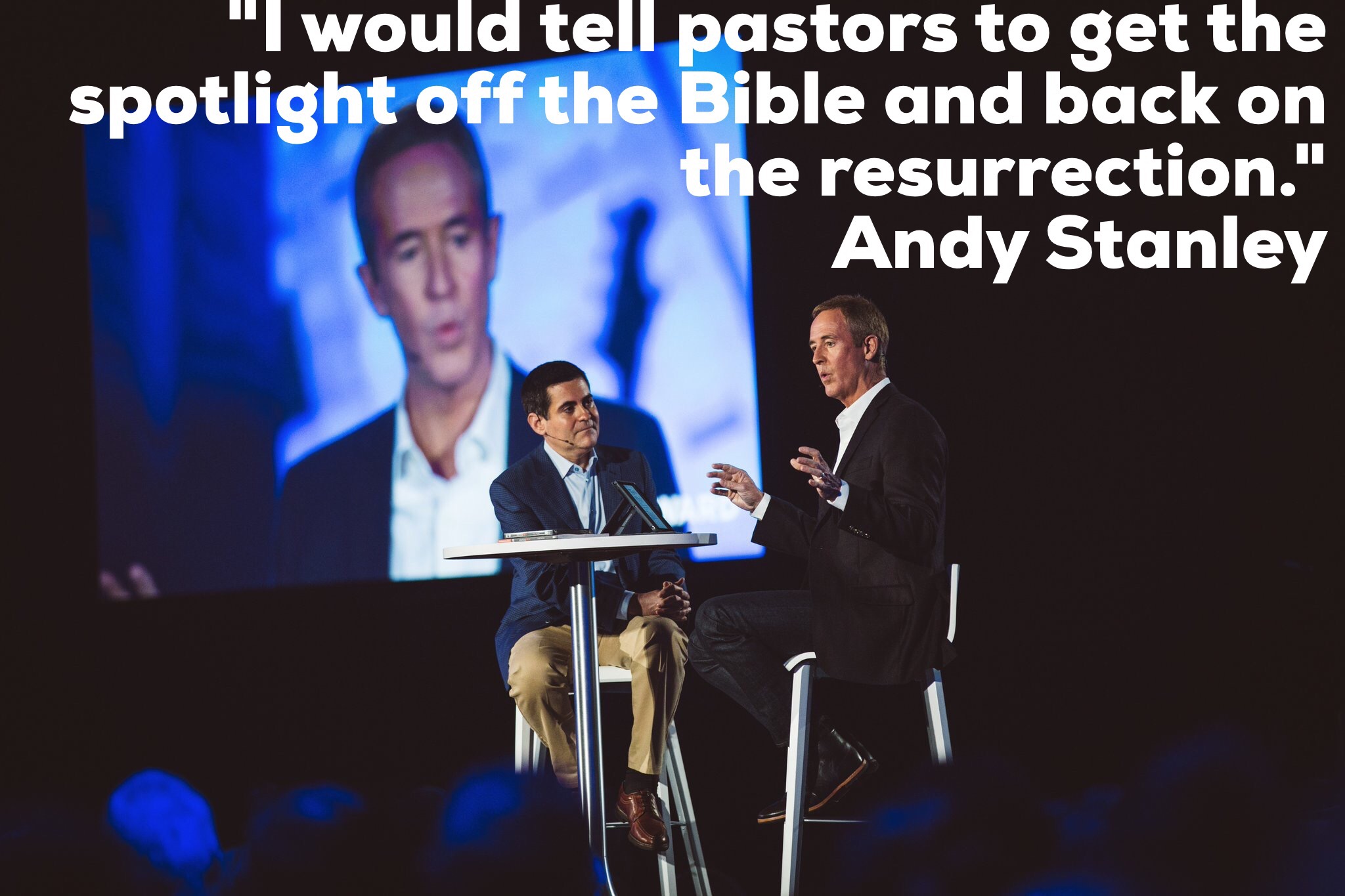
The Ethics and Religious Liberties Commission (ERLC) national conference kicked off yesterday and the theme of the conference is how to engage culture effectively with the Gospel. Dr. Russell Moore sat with Pastor Andy Stanley to discuss leadership, preaching and cultural engagement. 

In their conversation Pastor Andy Stanley speaking to pastors said “I would tell pastors to get the spotlight off the Bible and back on the resurrection.” As you can imagine Pastor Andy Stanley’s statement sent shockwaves throughout the twitter sphere. When I heard it I cringed a little and when ERLC releases the conference video I plan on relistening to their convertsation. But as I sat and contemplated what I heard of the conversation, I must say, Pastor Andy Stanley’s statement puts forth a false dichotomy. 

The Bible and the ressurection of Christ are not at odds with each other. The Bible is the spotlight a “lamp shining in a dark place, until the day dawns and the morning star rises in your hearts” (2 Peter 1:19). What is the Bible spotlighting? The life, death and ressurection of Jesus Christ. We would have no idea of the ressurection of Jesus without Spirit inspired writers informing us of the historical event.

One day when Jesus was engaging the religious culture of his day he said, 

You search the Scriptures because you think that in them you have eternal life; and it is they that bear witness about me, yet you refuse to come to me that you may have life. – John 5:39-40

Jesus was pointing out that the Old Testament Scriptures, which they studied profusely, bore witness to Christ. The Bible wasn’t at fault for their lack of recognition of truth it was their refusal to come. Jesus pointed out it was their hearts, which refused to come, as the reason they didn’t find life in Christ. So if you follow the thread in the passage, accepting Christ leads to life, but the only way we know about that life is through the Scriptures. The Bible and Jesus Christ are forever linked, you can’t come to Christ without the Gospel which the Scriptures proclaim and you will not understand the Scriptures without Jesus Christ. 

We must engage culture with the Gospel, which we find in the Bible. The content of our message is immutable, but how we engage the culture is crucial to being effective Gospel witnesses in the 21st century. Peter exhorts us to engage the culture with gentleness and respect. 

In the past our methods of engaging people with the Gospel have been cringe worthy. Instead of being Gospel people witnessing with gentleness and respect we have repelled people by our witness. I don’t know how many times I have heard “God created Adam and Eve not Adam and Steve.” Do we actually believe a comment like that will actually bring the LGBQT community to the table to discuss the Gospel. What about referring to those of another race as “those people” or racial slurs, do we really believe we are speaking with gentleness and respect? In our increasingly pluralistic and diverse society we must be wise as serpents and harmless as doves. The Gospel is offensive do not add to the offense by how you engage the culture. 

You can livestream the conference which kicks off at 8:30 am on Friday. 

Until Next Time 

Solo Deo Gloria

In The Beginning God Created Christmas

in-the-beginning-title-slide-message-series-950x712-1What is Christmas? Christmas has become so many things in our 21st century culture. Christmas has become a time of shopping and gift giving. Christmas is also a time for family reunions and get-togethers. Christmas is for church pageants and programs. A time of tree and house decorating with lights and ornaments and yet even for others it is a time for legal battles to get Christ out of Christmas. All that is fine, except for the last option, if that is your cup of tea. But I thought I would sit down this Christmas, open up the Scriptures and look back into history, look back to when God became a man.  This is the 1st in a 5 part Christmas Series.

knowing that you were ransomed from the futile ways inherited from your forefathers, not with perishable things such as silver or gold, 19 but with the precious blood of Christ, like that of a lamb without blemish or spot. 20 He was foreknown before the foundation of the world but was made manifest in the last times for the sake of you 21 who through him are believers in God, who raised him from the dead and gave him glory, so that your faith and hope are in God. (1 Peter 1:18-20)

In The Beginning God Created Christmas

In the beginning God created Christmas. Before the world was ever spoken into existence God planned for Christmas. Before the Creator of the world uttered let there be, He thought of Christmas. Before the hands of the Creator crafted Adam and Eve, Father, Son and Holy Spirit crafted the plans of the Son coming in the flesh for the redemption of man. In the beginning God created Christmas.

Peter tells us Christ coming was “foreknown before the foundation of the world”. So much grace and mercy flows from that phrase it is astounding. The Triune community made a plan for our redemption before you were born, before I was born and before Adam and Eve were ever made. Why did the Triune community of Father, Son and Holy Spirit create Christmas? Peter tells us, “So that our faith and hope are in God”. What does that say about our God?

Our God Is Love

knowing that you were ransomed from the futile ways inherited from your forefathers, not with perishable things such as silver or gold, 19 but with the precious blood of Christ, like that of a lamb without blemish or spot.

Peter points out believers are “ransomed from the futile ways inherited from your forefathers”. The Apostle Peter takes us back to the Garden of Eden to that fateful day. The day when Adam ate the fruit. Since that day humanity has been radically corrupted by sin. Plagued by a sinful condition right down to our core. This radically corrupted sinfulness has been passed down from Adam all the way to us in the 21st century. This condition causes our ways to be futile because they only lead to death physically and spiritually. Our condition is hopeless if left in this state.

But God, some of the greatest words ever penned in Scripture, but God knowing the crown of His creation, humanity, would bring sin in this world, He created anyway. Knowing humanity would be plagued by radical corruption because of the sin of Adam, He created anyway. Knowing all the travesties that would occur throughout human history, He created anyway. Knowing humanity would commit the ultimate travesty and reject the Creator and be disobedient, He created anyway.  My friend that is love.

This love goes further. Knowing He would craft a plan for the ransom of man, He created anyway. Knowing this plan would involve God becoming man, He created anyway. Knowing the 2nd member of the Trinity, Jesus the Son, would have to live a perfect life, suffer and die for a radically corrupted humanity, He created anyway. My friend that is supreme love.

Christmas is the demonstration of the love of God to fallen humanity. God the creator of time and space, steps into time and space. Jesus, fully God and fully man, steps into the world he created as the demonstration of the Father’s love. This demonstration of love would cost the Creator of life to lose his life in order that dead humanity can live.

Love Came For You

He was foreknown before the foundation of the world but was made manifest in the last times for the sake of you 21 who through him are believers in God, who raised him from the dead and gave him glory, so that your faith and hope are in God.

The Apostle Peter tells us that Christ came “for the sake of you”. Think back to the Christmas message to Joseph. Joseph is struggling because his betrothed told him she was pregnant. Joseph stuck between a rock and a hard place plans to divorce her quietly, but God. God intervenes through an angel and shares His Christmas plan with Joseph. The plan that was crafted before the world began and the angel declares, “you shall call his name Jesus, for he will save his people from their sins.” (Matt. 1:21b)

Peter in this passage is reiterating the Christmas message. Love came down expressed through Christ to save us from the futility of our sin. Love came down expressed through Christ so that through Him, the Way, the Truth and the Life, we may become believers in God. Love came down expressed through Christ “so that our faith and hope are in God”. My friends Love came for you and this love was planned before the world began.

In the beginning God created Christmas

Until next week

Soli Deo Gloria

Come and See

Come and see, those are some interesting words. We use them to incite intrest in others to come, look or experience something that is happening or has happened that is worth watching. Come and see this video. Come and see this sports play. Come and see this or that.

Here is my question, have we reduced our evangelism to come and see my church?

Come and see our great musicians. Come and see our great programs. Come and see our great communicator. Come and see our great facilities. Come and see… You get the point.

In John 1 we read about a couple of John the Baptist’s disciples leaving him to follow Jesus. They wanted to know where Jesus was staying, Jesus said “come and see” and they spent time together. Later on in the same chapter Andrew starts following Jesus and goes to grab his brother Peter saying “come and see, I found the Messiah.” So we see in Scripture that the come and see approach is used. What can we glean from the way Jesus and Andrew used “come and see” compared to the way we do?

Presence
We underestimate the power of presence.  When I read the Gospels I see that Jesus was among the people. Most of his time was spent serving the people. He didn’t put up a tent and wait around for people to come to Him. He went to the people to seek and save the lost. Jesus loved the lost, He spent time around the people, He engaged them in their neighborhood on their turf. When we have presence it shows we care about not only the stuff that happens at our church address, it shows we care about people. When we have presence people are more willing to respond to the invitation to come and see.

Seeker – Sensitive
Now before you label me a heretic or one of those guys, let me explain to you where I am coming from. By seeker sensitive I mean we need to make our hearts sensitive to seeking the lost. We should be the ones doing the seeking in this world. Our mission is the same as Christ to seek out the lost, proclaim the Gospel, so they may be saved. Sometimes we get too caught up in the routine of church life we forget our mission. In John 1, Andrew is the one seeking out His brother Peter to tell him, we found the Messiah. Peter isn’t the seeker here, Andrew is. Another interesting element to point out is the Bible says “first he found Peter,” which implies he didn’t stop with Peter. Andrew continued seeking out people to proclaim the Gospel and bring them to Jesus. Our hearts must be sensitive to seeking out the lost because at one time we were part of the family of lostness, but someone was sensitive enough to seek us out and share the Gospel. We must do the same.

All About Jesus
What we see very clearly in John 1 is everything must center around Jesus and the Gospel. Our presence, seeking and our invitation to come and see is all pointless if we never get to Jesus and the Gospel.  Everything we do, even the motivation for doing, must be about Jesus and His glory. All our church music, programs, communicators must be about Jesus or all we have is a social club. When John’s disciples left, they left because it was all about Jesus. When Andrew brought Peter it was all about Jesus.

In the book of Acts when the Gospel spread like wild fire it was because they had presence, they went to the people they didn’t wait for the people to show up. Their hearts were sensitive to seeking the lost. Most important is, it was all about Jesus. May we do the same.

Until next time
Soli Deo Gloria

The Search For New and Meaningful

One of the books I am currently reading is Captivated: Beholding the Mystery of Jesus Death and Resurrection and in the book Thabiti Anyabwile makes a thought provoking statement. “New and meaningful are often two different things. Many of us have accustomed to thinking that meaning comes from newness.”

In our society we have seemed to attach meaningful to newness. Our culture seems to be looking for the new way to lose weight, new way to get rich, new way to you fill in the blank. But just because something is new doesn’t mean it is meaningful and just because something works doesn’t make it ethical.

Some in the Church have seem to bought into this idea that new equals meaningful. We are always looking for that new book to take us to the next level. Looking forward to retreats, camps and conferences for a new experience. Even buy into some personalities that say they have a new word from God. But new isn’t always meaningful and in some cases the new that some people get involved in is down right dangerous.

We have seen in the Scriptures people get deceived by some that claim newness. Jude points to the fact that the false teachers in his day were relying on dreams and visions to proclaim their new revelation (Jude 8). The Apostle John encourages us to test the spirit (1 John 4). We are to discern weather the newness we are reading, listening to, or watching is true or false.

The call to discern makes the assumption we know truth. In order to discern truth from error, we need to know the truth. As believers we need to become so familiar with God and his Word that were not sucked in by the empty promises of the new.

Now, I read new books all the time, reading is one of my passions, especially when it comes to learning about God and his Word. But godly books will not point to new revelation but to God’s revealed Word. They will expound on the old truths in the Scripture that are very meaningful. They will point us to the words of truth which in turn point us to the Person of truth, Jesus Christ.

Just who is Jude?

20140117-130125.jpg

Do you remember the TV show Lost? I was a huge fan of the show. There were certain episodes that would start at the end of the story and work their way to the beginning. I feel I kind of did that here with Jude’s introduction. I started in the middle with Beloved, Called and Kept. Then moved on to Jude’s prayer of blessing for mercy, peace and love. Now let’s try and discover just who the author of Jude is.

Jude is short for Judas or Judah, which was a common name in that era. So it shouldn’t surprise us that there is more than one Judas mentioned in scripture. There is the infamous Judas Iscariot, the apostle that betrayed Jesus (Matt. 10:4). We know he didn’t write Jude because he committed suicide soon after his betrayal of Jesus (Matt. 27). There was another Apostle named Thaddeus (Matt. 10:4; Mk. 3:19), who also went by the name of Judas (Lk. 6:16; Jn. 14:22). We know that it wasn’t this Apostle Judas who wrote Jude because the writer of Jude seems to make a distinction between himself and the apostles (Jude 17). After the Apostle Paul’s conversion, Ananias was told to go to Paul, at that time called Saul, he was at the house of a man named Judas (Acts 9). There was also a Judas, called Barsabas, that was sent with Paul, Barnabas and Silas to inform the Gentile believers of the decision from the Jerusalem Council (Acts 15:22). I don’t believe either one of these Judas’ were the writers of Jude, mainly because we are never told that they have a brother named James.

The only other Judas it could be is Judas the brother of Jesus. The Gospels provide us a list of Jesus’ brothers, among them is Judas (Matt. 13:55; Mk. 6:3). The writer of Jude doesn’t identify himself as the brother of Jesus, but he does identify himself as the brother of James (Jude 1), who was also a brother of Jesus. James was very well known as the leader of the Jerusalem church and was referred to as a pillar by the Apostle Paul (Acts 12:17; 15:13; 21:18; Gal. 1:19; 2:9). So when Jude refers to himself as the brother of James his audience knows exactly who is writing to them, Jude the brother of Jesus.

The Bible doesn’t give us much information about Jesus’ brothers and sisters. But we do know that he had at least four younger brothers and at least two sisters. So Jesus was part of a large family. There are a couple of places in scripture that we can glean some insights concerning Jude.

Jude the Rejector

We know from the Gospels that Jesus’ brothers did not follow him. Honestly they flat out thought he was crazy (Mk. 3:21). Jesus began healing people, telling them He was God and started to develop a following. He even began to call specific disciples to walk with him. When his family saw all of this, it made them nervous, and quite honestly can you blame them? This is Jesus, the brother that grew up with them. I mean we might have thought the same thing. So what do his mother and brothers do? Yes, you guessed it, they plan an intervention. They go find Jesus and he is amongst a large crowd, people began to tell Jesus that his mom and brothers are here. Jesus answers and says, “whoever does the will of God, he is my brother and sister and mother (Mk. 3:35). We know that his brothers left that day as unbelievers, they rejected Jesus’ message and claims.

We have another recorded instance of Jesus interacting with his brothers (Jn. 7). At this time in Jesus ministry the crowds began to defect and the religious leaders wanted to kill him. Jesus goes to Galilee refraining from going to Judea because it is not his time yet. While in Galilee he runs into his brothers and they have an interesting conversation.

Now if you have brothers this conversation most likely makes sense to you. His brothers basically tell him, “hey Jesus, why are you hiding out here? If you are who you say you are go to Judea and put your works on display. Show the world who you are.” His brothers are not being supporters here, they are being sarcastic, and may I add that they know fully what would happen to Jesus if he went to Judea. They knew that the religious leaders wanted to kill him, everyone did, it was the talk of the town. Yet at this time Jesus’ brothers are not showing support but sarcastically ridiculing Jesus, their half brother, the Son of God. Jude rejected Jesus’ claims before the cross.

From Rejector to Contender

So what happened? How does Jude go from someone who rejected and ridiculed Jesus to writing one of the books in the New Testament? My friends, the Resurrection of Jesus changes everything!

We know from the Gospels that Mary, the mother of Jesus,watched her son experience a grueling death, death on a cross. The Gospels don’t tell us his brothers were around, but we can know for sure that they knew what was going on, everybody in the region did. We can be sure that Mary would have told her sons what she has seen and experienced. I am not sure what is going through their minds at this time- maybe guilt, sadness or relief that the spotlight is off of their family.

The Apostle Paul gives us one line that is the epitome of grace, “Then he appeared to James” (1 Cor. 15:7). I wonder how that went down, did Jesus show up and give James and his brothers the ultimate, “I told you so.” I doubt it, but Jesus does show himself to James, and we can safely assume that his other brothers and sisters, including Jude, were there. The resurrection of Jesus changed everything.

Now, this must be said, Being the brother of Jesus, Jude and his other brothers and sisters would have known Jesus. They grew up with him. I have brothers and sisters, and I could give a list that could fill hundreds of pages of why they are not God. But his family couldn’t point out one fault in our sinless Savior. That is amazing.

After the resurrection we know that no longer were they rejectors but believers and contenders of the Gospel of Jesus. We see that they are among the hundred twenty in the upper room (Acts 1:14). As we mentioned earlier, James became a pillar of the church in Jerusalem and a leader of the early church abroad. He wrote the book of James in the New Testament. Both James and Jude describe themselves as servants of Jesus Christ (Jas. 1:1; Jude 1). They don’t use the title, “brother of our Lord” as The Apostle Paul does, to describe themselves. This may reflect their humility. It certainly reflects on how they viewed their relationship they now have with Jesus.

We also know that Jude became an avid defender of the Gospel. In the book of Jude we have his great exhortation to “contend earnestly” which can also mean to continually fight. Fight for what? The faith, continually fight against those that pervert the Gospel. Continually fight to proclaim truth in the midst of lies, and false teachings in the church and outside the church. Jude went from rejector to contender because the resurrection changes everything.

But in my study of Jude and learning about Jesus’ family I found this one statement in the book of Jude very enlightening, “and have mercy on those who doubt;” (Jude 22). Could it be that Jude, while writing this line, was reflecting on his days before he was a believer. Not only was Jude a contender for the faith against those that pervert the Gospel, but he also knew that there were some who truly struggled with the truth. What does Jude exhort us to do with these that struggle with the truth? “Have mercy on those who doubt.”

Until next week as we look closer at the false teachers Jude is writing of may we become like Jude, contenders for the truth. May we know and love the truth and be avid defenders of it. May we also have mercy on those that honestly struggle with the truth and walk alongside them explaining and loving them and guiding them to the truth as if we are, “snatching them out of the fire;” (Jude 22).